
Beyond Business: What 10 Days in Senegal Revealed About Partnership and Responsibility

Updated: Jul 10
Barely out of the plane, Daniel's driver's license disappeared faster than we could say "Bonjour, Monsieur l'Agent." Reason: illegal parking. Classic. What followed was an hour of warm negotiation with the police — small talk, laughter, patience, a 3,000 CFA fine — and by the end, we almost knew each other personally.
That was Day One. And in a way, it set the tone for everything that followed.
From April 29 to May 9, my son Loïc and I traveled through Senegal — from the coast near Dakar down through Casamance, deep into the countryside around Bignona and Diouloulou. We were there to visit the farmers and entrepreneurs supported by our long-standing humanitarian partnership with the Swiss NGO Sénégalité. But what we came back with was something harder to put into a report: a renewed sense of what long-term commitment actually looks like, and what leadership means when you strip away the infrastructure most of us take for granted.

Why We Go Back
Swiss Interim Management has supported Sénégalité's microcredit program in Senegal for more than 10 years. The model is deceptively simple: young agricultural graduates from the Lycée Technique Agricole Emile Badiane in Bignona submit a business plan, receive an interest-free loan to start their own farm or agribusiness, and repay it — after which the funds are recycled to finance the next generation of entrepreneurs. No aid dependency. No handouts. Education, then entrepreneurship, then independence.
We go back because we want to see what actually happens over time. Not the launch, not the press release — the reality five, eight, ten years in. This trip gave us exactly that.
Raymond, and What Real Hospitality Looks Like
Photo: visit to Mbissel—hospitality and everyday life on Raymond Kaling’s farm.
Our first farm visit was with Raymond Kaling in Mbissel, south of Dakar. He met us at the Sacred Baobab — a tree so old and vast it makes you speak more quietly, instinctively. Then he took us to his farm.
No decor, no frills. Couscous and fish, served by a family that had clearly been looking forward to our arrival. That evening, Raymond's wife Emilie and their sons joined us for dinner in Mbour. Laughter, closeness, and that rare feeling — you're not just a guest, you're almost family.
Raymond also showed us his half-finished house. The roof is about halfway done. It will take roughly 630,000 CFA to complete. He told us this simply, directly, without drama. No performance of poverty, no request. Just: here is where things are.
That honesty is something you notice again and again in Senegal. It's not a culture that wraps difficulty in euphemism.
42 Degrees and a Woman Running a Farm on WhatsApp

Photo: farm encounters—people, animals, and daily life in Fissel/nearby.
Khady Saar's farm in Fissel was our next stop — in 42-degree heat. Khady herself was in Dakar that day, but she was completely present via WhatsApp: answering questions, guiding us through the property, engaged in every detail of a farm she clearly knows inside out.
Her needs were clear: solar panels, a freezer, a better pump. Small investments. She could name them precisely because she'd already planned exactly what they'd unlock.
This kind of clarity — knowing what you need, knowing what it would do — is something we saw everywhere. These are not people waiting to be told what to do. They are entrepreneurs running real businesses under conditions most of us would find paralyzing.

Photo: saying goodbye to Khaddy Saar and her sisters.
The School Behind the Story

Photo: Director Ibrahima Abdoul Aziz Ficou of the Lycée Technique Agricole Emile Badiane.
Before heading deeper into Casamance, we stopped at the Lycée Technique Agricole Emile Badiane in Bignona — the school at the center of the whole model. Director Ficou welcomed us with what can only be described as genuine joy and walked us through the facilities.
The dairy processing unit was improvised and basic. Fire on the floor. Minimal equipment. But it was functional — and more than that, it was real. Students here learn by doing, on-site, with the materials and constraints they'll face when they leave. There are no labs designed to make things look easier than they are.
Later, we met Ibou Diedhiou, the school's founder and former director, now retired, now farming his own orchard. He studied engineering in Toulouse, Montpellier, and Dijon. He's traveled the world. He chose to come back and build something here. That's worth sitting with.

Photo: Lycée Technique Agricole Emile Badiane and the food processing unit.
Boubacar's Farm: Swiss Order in the Senegalese Bush

Photo: farm visit near Diouloulou—here, Boubacar Goudiaby’s sister, Fatou.
If one visit summed up what this program can produce over time, it was Boubacar Goudiaby's farm near Diouloulou.
He met us on his red motorcycle on the main road — right after four speed bumps — and guided us through the bush to his property. The moment we arrived, you could feel his pride. And he had every right to it.
Three hectares are planted with oranges, mandarins, and papayas. Solar-powered irrigation. A new building with a shop and storage space. An intern. Everything clean, swept, and organized. One of our team described it as Swiss-level order in the middle of the Senegalese bush — and that's not a small thing to say.
To say goodbye, Boubacar gave us a whole bag of fruit for the road.
There's a word for what Boubacar represents that isn't quite "success" in the conventional sense. It's more like dignity through ownership. He built this. It's his. The microloan was the starting point — what came after was a decade of decisions, work, and discipline.

Photo: a look at the fields, irrigation, and organization.
Abdina: A Bicycle from The Gambia, and a Chicken Coop Already Built

Photo: farm and family life—animals, work, and moments of visit with Abdina Diédhiou.
Boubacar then guided us further into the bush — on a track that was, generously, exactly the width of our Mitsubishi Pajero — to visit his neighbor, Abdina Diedhiou.
Abdina wasn't home when we arrived. His wife greeted us and walked us through the compound, which included young lemon seedlings, pineapples, hibiscus, eight pigs, and a boar. Then Abdina arrived — from The Gambia, by bicycle. He'd crossed the border to buy faucets, because they were cheaper there.
No electricity. Water from the well. And still: a chicken coop already built, ready for 100 to 200 birds. He was feeding the pigs with one hand and holding his small daughter, Bettina, with the other.
He gave us a huge bag of oranges before we left.
Mame Samba: Thinking Like an Agronomist
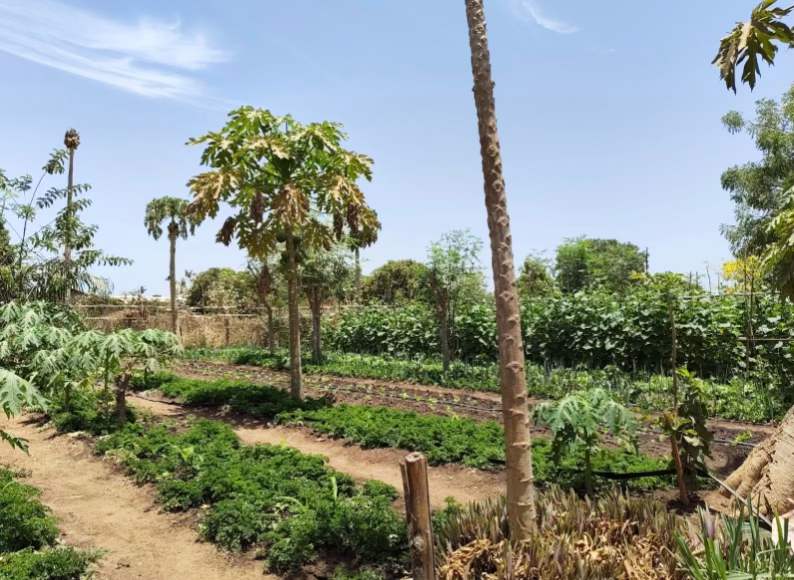
Photo: vegetable plots at Mame Samba Ndiaye’s—neat beds with companion planting, papayas in the background.
The most technically sophisticated operation we visited was Mame Samba Ndiaye's farm outside Bignona. He practices companion planting consistently — at least three different crops per bed, corn providing shade for celery underneath, designed to prevent disease and extend the productive life of the soil. Drip irrigation, supplemented by watering cans. A nursery section growing papayas, bananas, avocados, mangoes, and coconuts — all in excellent health, managed by two women interns.
He teaches agronomy to others. He collaborates closely with neighboring farms on sales. He's currently testing fish farming — one pond so far, results not yet satisfactory, so he's planning a second in a different location to learn more. A greenhouse project is in early stages of thinking. Three more hectares, 80 kilometers away, are being considered for expansion.
Not everything works yet. His new irrigation pump draws more power than his current solar panels can supply — he's looking for a technician or will resell it. That's the reality of building something from the ground up, without the capital buffers most entrepreneurs in Europe take for granted.
What struck us most was how he thinks. Not just about this season, but about systems, soil health, markets, and the next five years. That's not what a microloan teaches you. That's character.
The Fish Beach at Kafountine
Not every moment was a farm visit. One morning, we walked the beach from our lodge to Kafountine — and found ourselves in the middle of one of the busiest, most overwhelming working scenes either of us had ever witnessed.
Hundreds of painted fishing pirogues are packed tightly together on the sand. Fishermen unloading their catch directly onto the beach. The immediate chaos of sorting, estimating, counting, paying, arguing, recounting, paying anyway. Young men moving plastic crates at a run. Thick smoke from the drying tables. The sand was blackened by embers. Our clothes smelled of it for hours.
We met Kofi from Togo there — he'd lived for a while in Winterthur, Switzerland, and spoke about the mountains between Uri and Lausanne with genuine warmth. Beautiful, he said. But the heights gave him vertigo. The better the view, the worse he felt.
Something in that landed with both of us.
What Stayed
Ten days is not long enough to understand a place. But it's long enough to have your assumptions rearranged.
What stayed with us wasn't the poverty, or the heat, or the logistical chaos — the wrong insurance papers, the lost phone at the Dakar gate, the two-hour flight delay that nearly cost us our Madrid connection. Those things become the stories you tell. They're not what changes how you think.
What changes how you think is sitting across from someone who built something with their hands, on hard ground, without a safety net, and watching them show it to you with quiet pride. No self-pity. No resentment. Just: this is what I made.
Leadership gets talked about a lot in the circles Swiss Interim Management operates in — boardrooms, executive teams, and organizational transformation. What we saw in Senegal was a different register of it. People running complex operations under real constraints, making decisions every day with incomplete information and limited resources, and doing it with dignity, generosity, and — consistently — humor.
The fruit they pressed into our hands as we left each farm was not incidental. It was the same impulse that drives good leadership everywhere: you give what you have.
Why SIM Supports This
Swiss Interim Management is in the business of transition and leadership. We support organizations navigating change — bringing the right people, the right perspective, the right moment of clarity to situations that need it.
Our partnership with Sénégalité is an expression of the same values, in a different context. Not charity. Not an image. A long-term commitment to a model that works — because it's built on competence, accountability, and the belief that people, given the right tools and trust, will build something worth returning to see.
We've been returning for more than ten years. We'll keep going back.
Swiss Interim Management supports the Sénégalité microcredit program for agricultural graduates of the Lycée Technique Agricole Emile Badiane in Bignona, Senegal. Learn more: www.senegalite.ch



A powerful reminder that sustainable change begins with trust, education, and personal responsibility. 🌍
What inspired me most is that these entrepreneurs are not asking for handouts—they are building businesses, creating opportunities, and shaping their own future through hard work, vision, and perseverance. Their stories show that real leadership is not defined by resources, but by resilience, commitment, and the courage to act.
Thank you for sharing these meaningful insights and for demonstrating that long-term partnerships can create lasting impact across generations. 👏🌱 #Leadership #Entrepreneurship #Sustainability #Senegal #Partnerships